Behavioral change / Culture transformation

evolv e&: engineering behavioral change and shedding the light across a 6,000-person workforce

An integrated marketing communications campaign that turned a taboo workplace subject into a company-wide movement, shifting both attitudes and actual reporting behavior in under six months.

Company
etisalat by e& Egypt
Role
External & Internal Communications
Period
November 2022
Scope
6,000+ employees across corporate, retail & field operations

Nobody at etisalat by e& was talking about workplace bullying. Not because it didn't exist. Because in an Eastern corporate environment, or at any company for that matter, these conversations carry a weight that people outside the region rarely understand. Cultural norms around hierarchy, respect, and conflict avoidance mean that harassment, emotional abuse, aggressive email tones, and public humiliation in meetings all get absorbed silently. Everyone knew it happened. Nobody had a vocabulary for it, and nobody had permission to call it what it was.

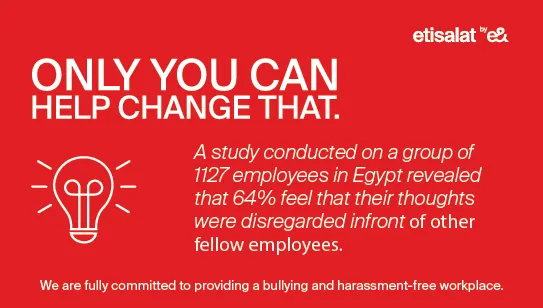
Our internal pulse surveys hinted at the same patterns that global research was uncovering, but the numbers were suspiciously low. That gap between what we sensed and what the data showed told us more than any survey result could. People were not reporting because they did not feel safe enough to report. Amy Edmondson's research on psychological safety explains this precisely: when employees believe they'll be punished or humiliated for speaking up, silence becomes the rational choice. We were looking at a classic case of underreporting driven by fear, not an absence of the problem.

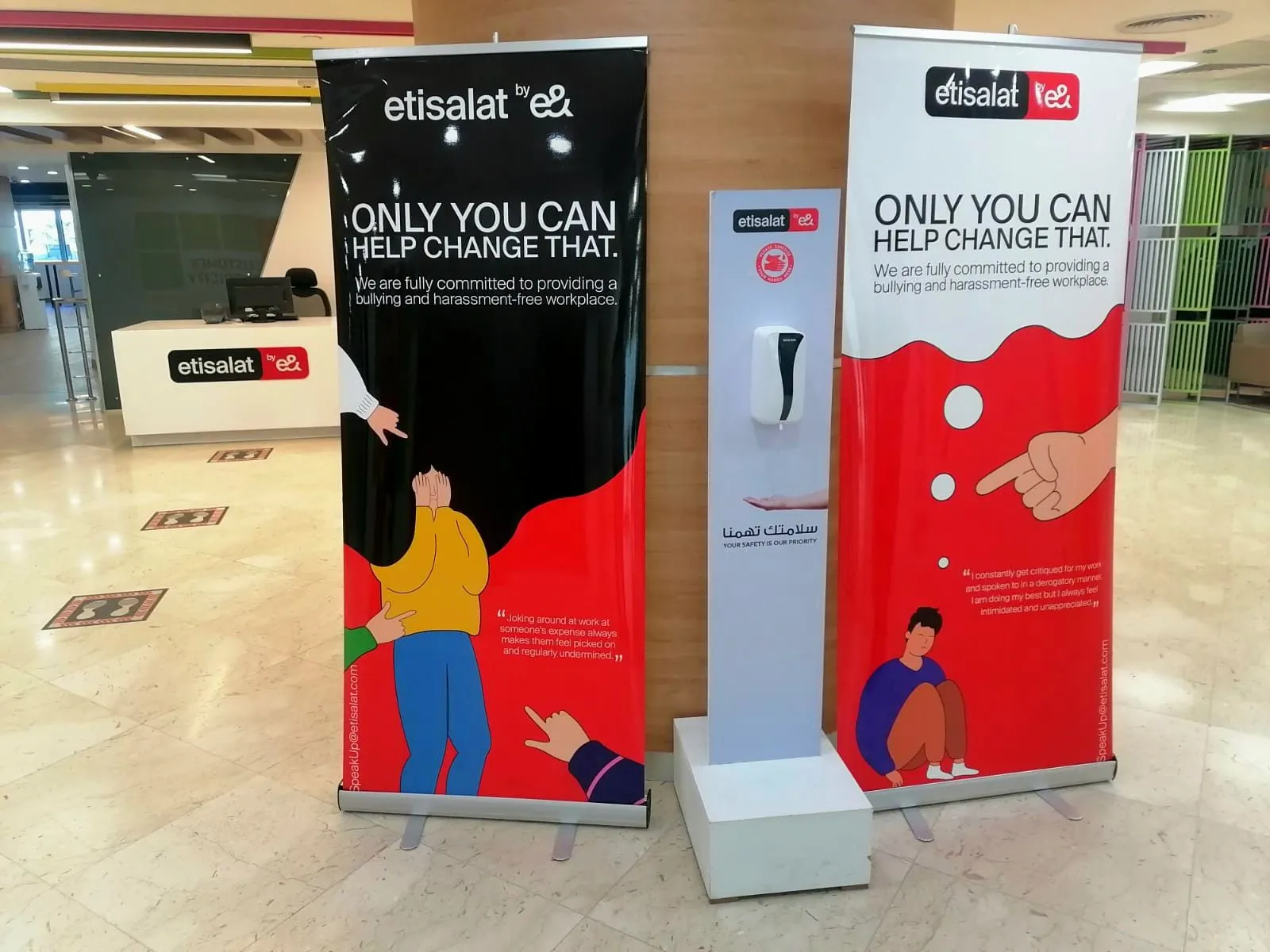
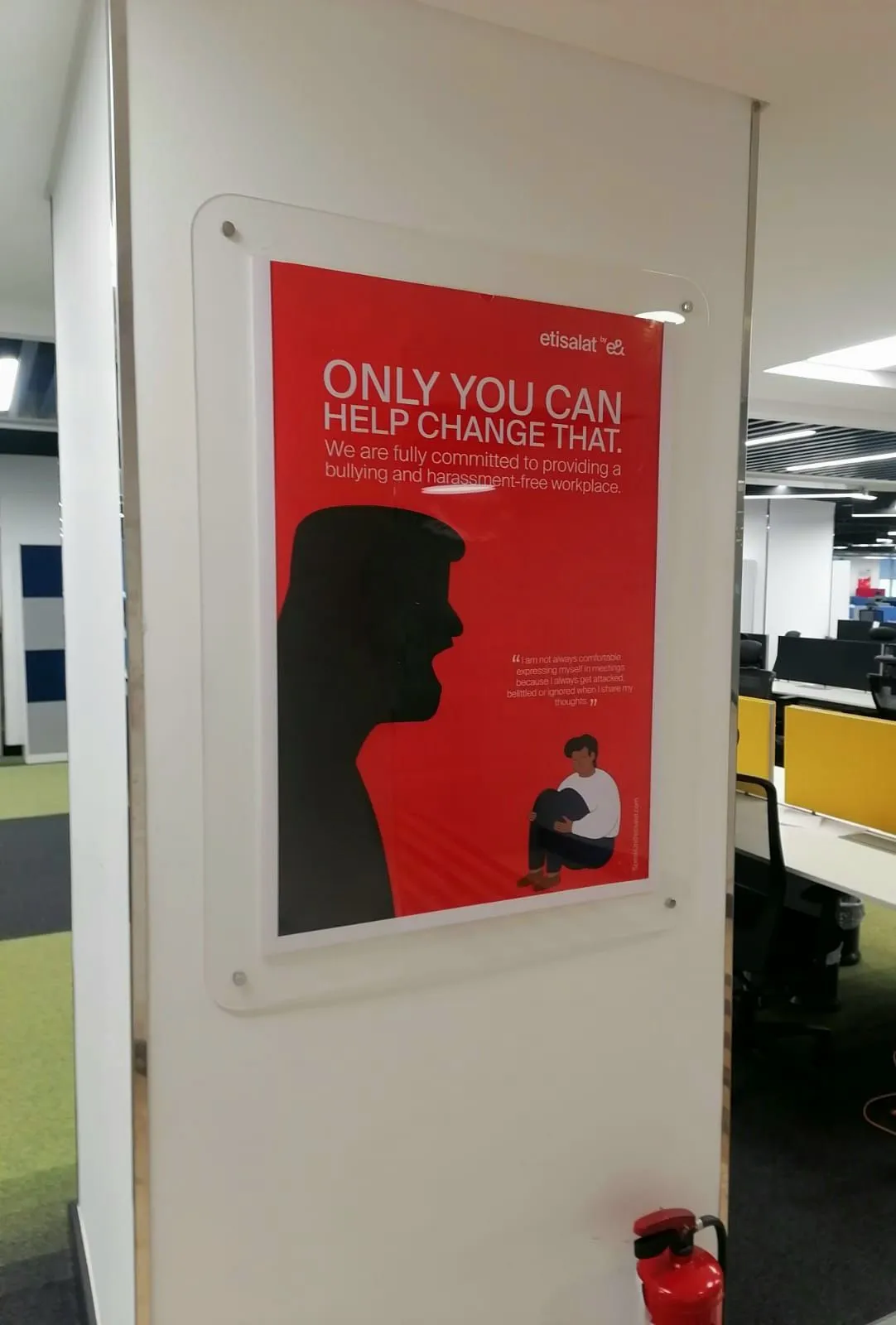
Anti-bullying campaign poster deployed in etisalat office

The creative concept: evolv e&

The concept we landed on was called "evolv e&." It was built on a provocation: evolution requires discomfort. You don't change a culture by making people comfortable with the status quo. You change it by making the status quo harder to accept than the alternative.

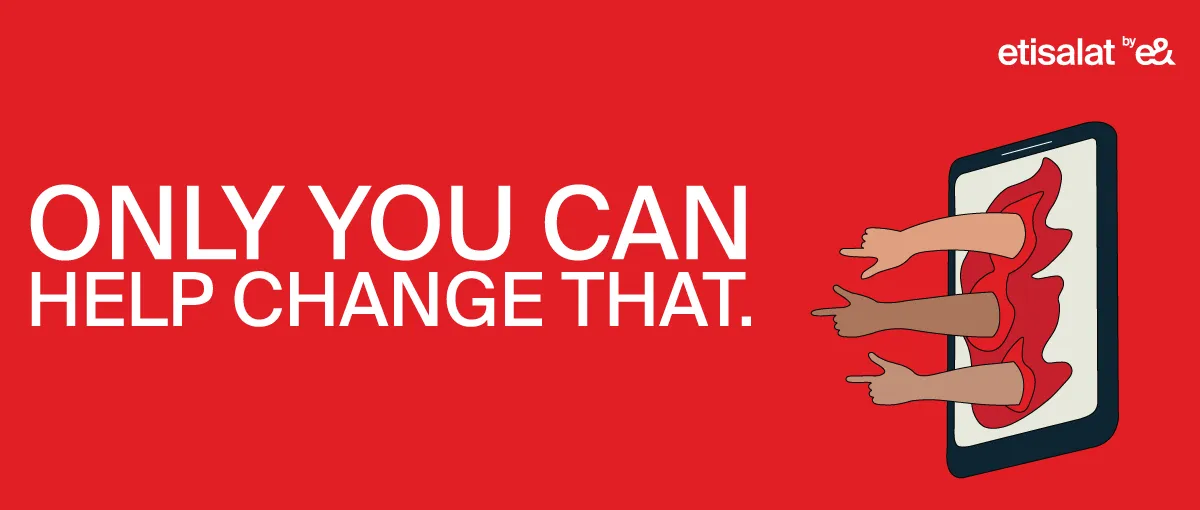
The campaign line was "Only You Can Help Change That." That phrasing was not an accident. There is a well-studied problem in behavioral science called diffusion of responsibility, first identified by Darley and Latane after the Kitty Genovese case. In group settings, people assume someone else will act. The larger the group, the less personal responsibility anyone feels. Darley and Latane found that 85% of individuals intervened when alone, but only 31% intervened when four other bystanders were present. By singling out the individual with "Only You," we were doing something specific: reversing the diffusion effect. Bandura's Social Cognitive Theory calls this activating personal agency, the belief that you, specifically, have the capacity to influence your circumstances. The line was not a slogan. It was a behavioral intervention disguised as one.

We organized the work into three phases, each with its own communication objective and its own set of touchpoints.
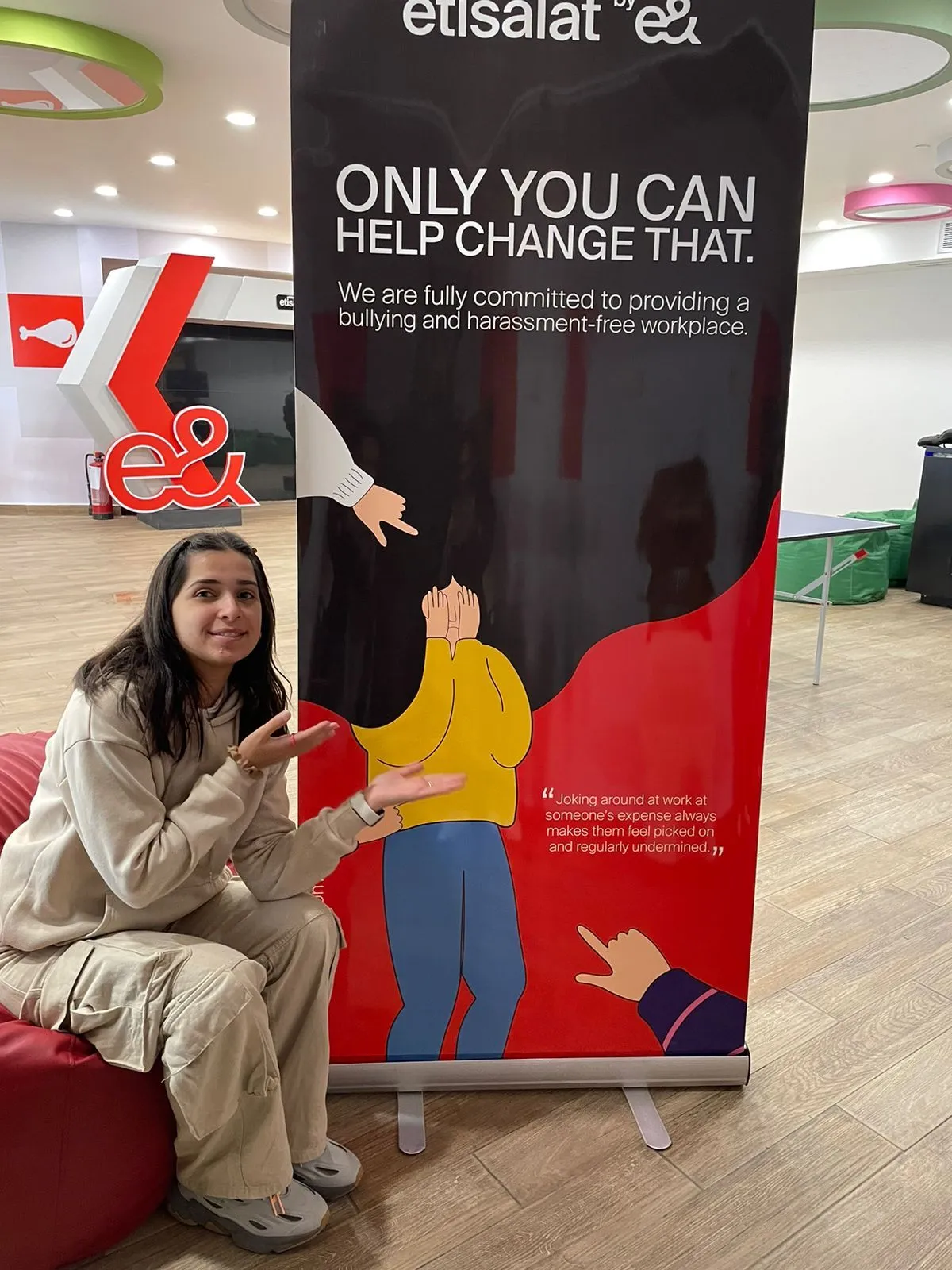
Employee posing with evolv e& campaign roll-up banner

Educate

The first barrier to behavior change was a knowledge gap. Most employees could not define the types of harassment they were surrounded by. In an Eastern cultural context, the line between "that's just how things are" and "that's actually harassment" is blurry enough that people genuinely don't know where acceptable behavior ends and abuse begins. Tichenor's Knowledge Gap Hypothesis tells us that when people lack the vocabulary to identify a problem, they cannot act on it. You can't report something you can't name. This phase used teaser emails, announcement emails, SMS, and internal posters to introduce vocabulary, statistics, and the campaign identity. The goal was to close that gap and give people a shared language they could use when they finally had the courage to speak up.

Eliminate

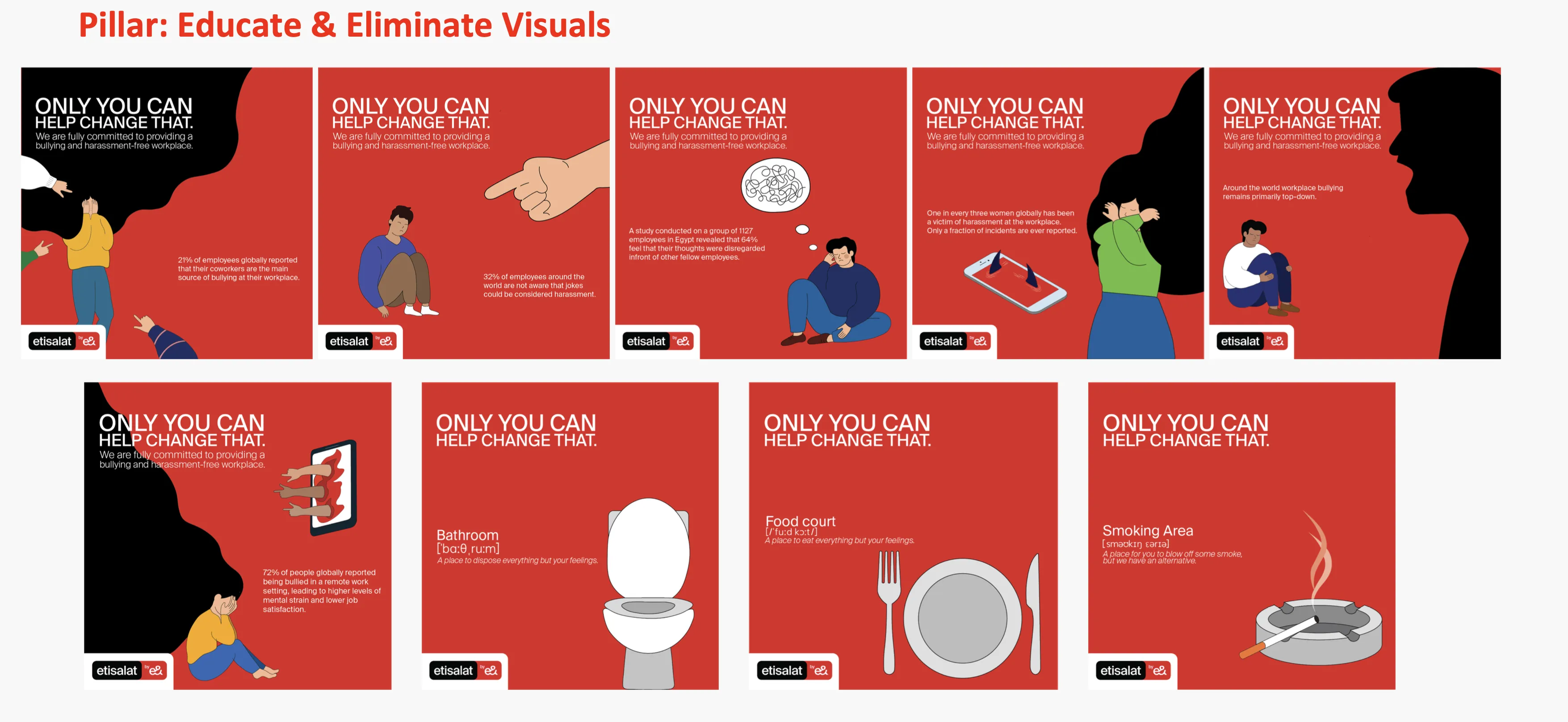
This was the phase that made the campaign real. The Intuition presentation framed it clearly: we needed to locate where employees go when they want to unfold and vent, the most authentic vulnerable spaces in any workplace. The bathroom is where employees go to break down and cry. That's not an assumption, that's an observable pattern in any office. Research in environmental psychology shows that vulnerability in communal private spaces leads to people opening up to one another. We installed dictionary-style definitions of bullying and harassment on bathroom stall doors, elevator wraps, smoking area walls, and cafeteria surfaces. Printed matter, not screens. You could not swipe past it or minimize the tab. Thaler and Sunstein's Nudge Theory calls this choice architecture: restructuring the physical environment to make a desired behavior easier and more natural. By placing definitions and the reporting email (evolve@etisalat.com) in these spaces, we intercepted people at the exact moment they were most likely to be alone with their thoughts and most receptive to the message.

Encourage

Convert attitude into sustained behavior. We partnered with Safe Egypt to run two live workshop sessions on sexual abuse awareness, anti-bullying, and safe working space practices. These were facilitated by professionals, not HR. That distinction mattered. It gave the sessions credibility and made people feel like the company was investing in real expertise, not checking a box.
The communication architecture

The rollout followed a sequenced, multi-channel cadence across November 2022. Every touchpoint had a purpose in the persuasion sequence. We mapped each one against the ADKAR stages and what communication objective it was meant to achieve.

Campaign in action

The physical campaign was deployed across all etisalat by e& Egypt offices in Cairo. Roll-up banners in lobbies and entrances. Posters on every floor. Elevator door wraps that you literally walked through to start your workday. The illustrated visual style was intentional: approachable enough that people stopped to look, serious enough that nobody mistook it for decoration.

Full campaign visual system — Educate and Eliminate phase posters and activations
Measured impact
+300%
Increase in employee incident reports through the dedicated evolve@etisalat.com mailbox within six months of campaign launch. This is a positive indicator, not a negative one. It means people felt safe enough to speak up.
45%
Improvement in knowledge and awareness scores on the post-campaign employee survey, measured using a retrospective pre-post design to account for response shift bias.
82%
Of Safe Egypt workshop attendees rated the sessions as "highly impactful" in anonymous post-session evaluations.
3.8x
Increase in employees citing "respectful workplace" as a top organizational value in the Q1 2023 engagement survey, compared to Q3 2022 baseline.

We also ran focus groups three months after the campaign ended. The qualitative shift was as telling as the numbers. Employees described a before and after. Before the campaign, they had no language for what they experienced. After it, they did. Several participants mentioned the bathroom stall activations specifically as the moment they realized the company was serious. One person said she had never seen any organization in Egypt talk about this openly. That feedback told us more than any survey score could.

What I took away

Most behavioral change campaigns fail because they treat communication as distribution. They blast a message, count the impressions, and call it done. That is not how attitudes shift. Abawari's 2024 study across 16 public organizations found that culture has a 0.52 direct effect on change management outcomes, and that effect is mediated by leadership visibility. The IoIC's IC Index found that when internal communications are rated excellent during a transformation, trust in senior leadership jumps to 78%. When they are rated poor, that number collapses. Communication is not a support function in a change program. It is the mechanism through which change either happens or doesn't.
The evolv e& campaign was a behavioral intervention built on integrated marketing communications methodology. We used Schein's model to diagnose what the culture actually needed, ADKAR to sequence the touchpoints in the right order, and Nudge Theory to design the physical environment so it worked for us instead of against us. The creative reversed diffusion of responsibility by speaking to people as individuals, not as an audience. And we measured the outcome at the level of actual behavior change, not awareness recall.
The part I keep coming back to is the reporting number. A 300% increase in incident reports through the dedicated mailbox sounds alarming if you don't understand what it means. But the IoIC data and Albrecht's change engagement research both point to the same conclusion: when people report more, it means they trust the system. The barriers to speaking up have come down. The campaign didn't create more bullying. It gave people permission to name what was already there. And that, more than any survey score, is how you know a behavioral change campaign actually worked.
NEXT PROJECT
Launching a Premium Card to the UAE's Elite →